
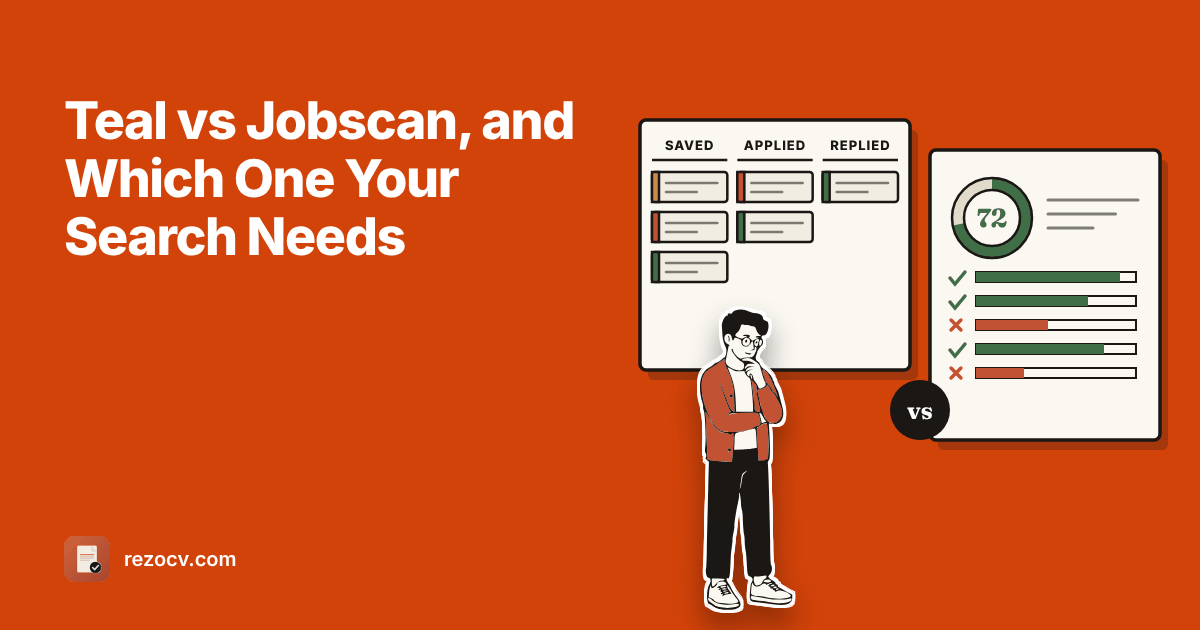
Short answer: Teal and Jobscan are not two versions of the same tool. Teal organises a job search: you save roles, record where each application stands and keep your CV versions in one place, for $29 every 30 days or nothing at all on the free plan. Jobscan checks one CV against one posting in more detail than anything else in this category, and costs $49.95 a month. If you have lost track of your applications, take Teal. If you are applying to a few roles through Workday or Taleo and want the formatting checklist for each one, take Jobscan.
I built RezoCV, which competes with both, so read this accordingly. Every price below comes from each tool's own pricing page, checked on 26 November 2026. Where RezoCV fits comes at the end, and briefly.
When I ran an architecture office, every project had two documents nobody confused: the drawing register, which said which version of each drawing was current and who had it, and the code check, which said whether one drawing met the regulations. Teal is the register. Jobscan is the code check. Neither of them designs the building, which is worth remembering now that both sell "AI".
The prices, side by side
| Free plan | Paid | What paying adds | |
|---|---|---|---|
| Teal | Unlimited tracking and CVs; 5 AI bullet credits, 2 summaries, 2 cover letters | $13/7 days, $29/30 days, $79/90 days | Unlimited AI writing, all keywords, match score |
| Jobscan | 5 CV scans a month, job tracker, CV builder | $49.95/month, or $89.95/3 months | Unlimited scans, AI rewriting, cover letters, LinkedIn optimiser, 2 Auto Apply credits a month |
Over three months the two are close: $79 on Teal's 90-day plan, $89.95 on Jobscan's quarterly plan, which also comes with a seven-day free trial. Month to month they are not: $49.95 against $29. And Teal's weekly plan is the trap in this table. Four weeks of it costs $52 for what the 30-day plan sells at $29.
What Teal is better at
Running the search. Save a role from almost any job board with the browser extension and it lands on a board where you set its status, take notes, record who you spoke to and draft follow-up emails from a template for each stage. If twenty applications are in flight and you cannot remember which ones answered, Teal fixes that directly.
A free plan you can keep. Teal Free is not a trial. Tracking and CV versions stay unlimited for as long as you want them. The AI allowance on it is thin, fewer bullet credits than when I checked in August, but for tracking alone you never need to pay.
CV versions. Unlimited CVs, so you can keep one per type of role and tailor from the closest one.
What Jobscan is better at
The depth of one comparison. Jobscan's match report is the most detailed in this category, and its synonym detector means "people management" and "team leadership" are not counted as a miss.
Advice tied to the employer's system. Paste the job link and Jobscan works out which applicant tracking system sits behind it from the address (myworkdayjobs.com is Workday, taleo.net is Taleo) and shows the formatting notes for that system.
Be precise about what that is. It does not connect to the employer's ATS, and nothing is tested against it. It reads the URL and shows advice you then apply yourself, and most of that advice is the same everywhere: one column, standard headings, consistent dates, no text inside graphics. What an ATS actually reads explains why.
LinkedIn. The paid plan includes a LinkedIn profile optimiser. Teal has a LinkedIn profile review too, but not as part of the same match workflow.
What changed this year
Jobscan's paid plans now include Auto Apply credits, two a month, with more sold at a discount. That is a step toward sending more applications, and it puts Jobscan closer to tools like LoopCV and JobCopilot than it used to be. Teal has stayed where it was: a tracker with writing tools around it.
Where they overlap
More than the marketing suggests. Both have a tracker (Jobscan's is on its free plan too), both score your CV against a posting, both write bullets and cover letters, both have a CV builder. The real difference is which half each one is built around. Teal starts from the search and adds analysis. Jobscan starts from the analysis and adds a tracker.
You can use both for nothing
Teal Free for tracking, plus Jobscan's five free scans a month for the roles that matter most. For someone applying carefully to a handful of jobs, that combination costs nothing and covers most of what either paid plan sells.
Which one to pick
- You have lost track of your applications. Teal, and the free plan is enough.
- You are applying through Workday, Taleo or iCIMS and want the formatting checklist. Jobscan, starting with the five free scans.
- You want both. Teal Free plus Jobscan Free.
- Your search will last a few weeks at most. Teal's 30-day plan at $29, not the weekly one.
- Your CV scores well and still gets no replies. Neither of these, and that is the next section.
Where RezoCV fits
Both tools measure how closely your CV matches a posting. Neither tells you whether you should apply at all, and a high score with no replies is usually that problem, not a keyword problem. The five jobs of a job application breaks down where applications actually fail.
RezoCV scores the fit across required skills, core responsibilities, scope and domain, says whether a seniority gap runs under the bar or over it, and says so plainly when the gap is too wide to close on paper. Then it rewrites your experience for that role without inventing figures, drafts the cover letter and rehearses the interview with you. It never applies on your behalf.
It costs €19 a month. The free trial lasts three days, needs no card, and includes your first full application, which is enough to see your own CV scored against a real posting. RezoCV vs Teal and the comparison with Jobscan, Teal and Rezi go further.
Questions people ask
Is Teal better than Jobscan?
For managing a search, yes. For checking one CV against one posting in depth, no. They are built around different halves of the job, which is why so many people use one free and pay for the other.
Is Jobscan worth $49.95 a month?
If you are applying to a small number of roles through large employers' systems and want the most detailed keyword report, it can be. If you are watching your budget, the quarterly plan works out at $29.98 a month, and the free plan's five scans cover the basic check.
Does Teal or Jobscan get your CV past the ATS?
Neither can, because there is less to get past than you have been told. The figure that 75% of CVs are rejected by software before a human sees them traces back to a 2012 claim by Preptel, a company that sold CV optimisation, as Fortune reported in 2014. Most systems search and rank rather than reject. What these tools really catch is a CV whose text does not extract cleanly, and the words from the posting you left out.
Which has the better job tracker?
Teal, clearly. Jobscan's tracker is a useful extra. Teal's is the product.
Does either one do mock interviews?
Teal does not. Jobscan sells Interview Practice separately, with a discount on paid plans. RezoCV includes a mock interview with critique of each answer in the same plan.
Prices checked 26 November 2026 on Teal's pricing page and Jobscan's plans page. Tools change their pricing; if you spot something out of date here, tell me and I will fix it.